

No matter what project you are working on. Whether you’re creating a new mobile App. You’re introducing a new way of working into your organisation. You’re creating a new facility, like a manufacturing plant. You’re designing a new product. You will want to collect ideas, features, requirements, risks, process requirements etc. From all your stakeholders and digital personas.
Brainstorming workshops are a great place to start!
Start with a Mind Map
A mind map is used in brainstorming workshops to pictorially represent information relating to a project. A mind map is a diagram that’s used to structure ideas and requirements into a basic organisation and hierarchy.
I like to use this approach as a first step, before proceeding to the ideas workshop stage. Because it gives a project an overall framework, which is always a good way to start.
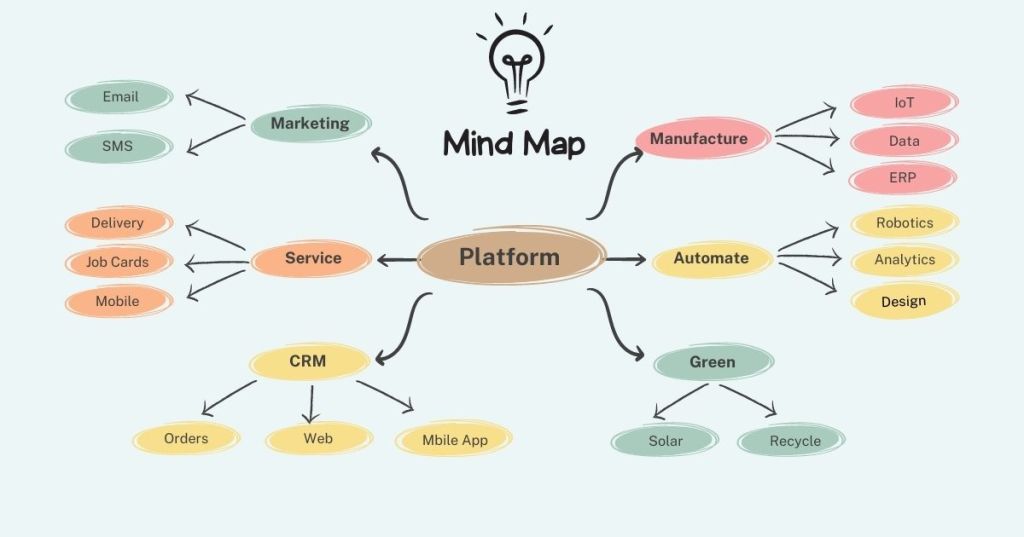
Step-by-step:
- Start by writing down the name of your main concept. This will be the root of your mind map and the point from which all branches derive. This can be the name of your project.
- Next, add the branches that link to your main topics. These will be used to organise your mind map into categories. Topics can be areas of interest like department name, project area, etc.
- Now, add in the branches for each topic. These will form the sub-topics. Which can be specific items of information such as requirements, ideas, sub-categories.
- Colour code each branch to provide an immediate visual representation.
Workshop Your Ideas
A great way to elaborate on a mind map and move your requirements gathering forward, is to gather the stakeholders and digital personas from each area. And begin to workshop the ideas from the brainstorming sessions.
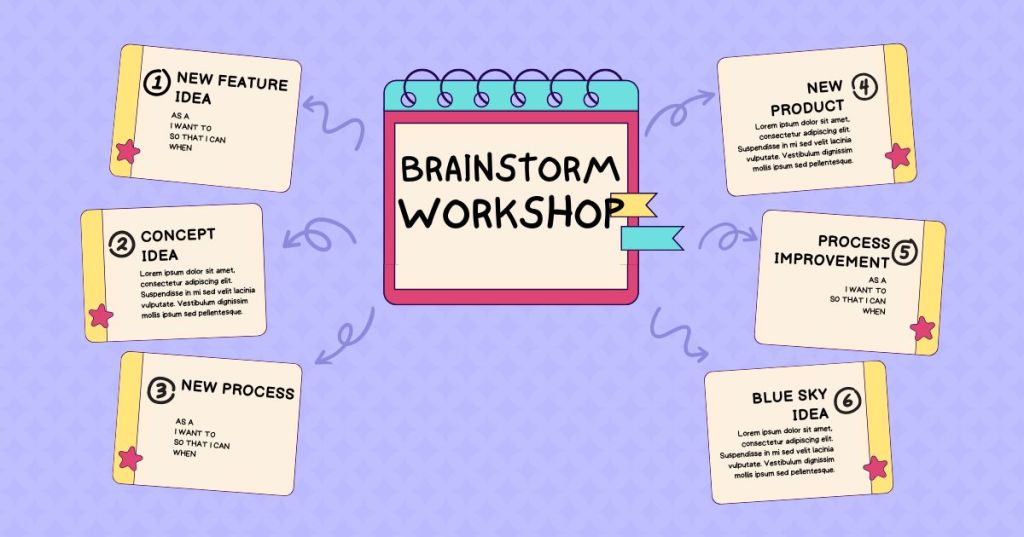
The brainstorming workshops are very loose in structure. In fact they don’t have much structure at all. And that’s what you want at this stage. You want participants to be relaxed. Come up with ideas off the cough. Without constraints. Think of it as a way of filling-in the canvas from the framework you created in your brainstorming sessions.
There are software packages available to record workshop ideas. Kanban tools can also be pretty good. But this can as easily be done old school, with sticky notes and colour pens. A the end of the day, it doesn’t matter how you capture the input from your audience, as long as it’s captured.
Step-by-step:
- Book a meeting room.
- Gather your audience. Stakeholders and digital personas. Put up A0 sheets of paper on the wall. One sheet for each area of interest. A good starting point for this can be the main topics from your mind map.
- Write each idea, requirement, feature, thought, on a post-it note and stick it in the relevant area of interest A0 sheet. You can write each note in free-text form or as a mini user story. The important things to capture are the idea itself and the person who’s idea it is.
- Once you’ve captured all the ideas, requirements, features, risks etc. A useful tip is to use your mobile phone to take a photo of each A0 sheet, especially if you’ve used a temporary medium such as a whiteboard. The information can be recorded electronically later on. The important thing at this stage is to ensure every idea, thought, requirement, feature, risk. And whatever else you deem important to your project is captured.

 Wow Bang Boom®
Leave a reply to Optimising User Stories – Wow Bang Boom Cancel reply