
My name is Richard McDowall. I’m the founder of Wow Bang Boom Ltd, the IT consultancy specialising in technology to improve business performance. And in my AI Series I share my findings from my research into AI.
In my previous article in the AI Series, I did an introduction into machine learning. You can find it here.
Remember that machine learning is the ability to teach computers to learn for themselves. You’ll probably use machine learning in some form or another every single day. Examples of machine learning are:
- Streaming Service Recommendations – When you’ve finished watching a movie on your favourite streaming service, and the streaming service gives you recommendations for other movies you might like. That’s likely to be machine learning.
- Talk to my mobile phone – When you ask your phone “Hey, Siri, play a song by Pearl Jam”. That’s machine learning.
- Manufacturing Quality Control – The automated detection of defects in the manufacturing process. That’s machine learning.
Today’s article is also about machine learning, today I delve a little deeper into how machine learning actually works.
Machine learning differs from normal software development in that we use special code, rather than our own intuition, to improve how well the machine learning software works. Ultimately the goal of machine learning is to find patterns in data, and use these patterns to make estimates. There are two types of machine learning:
- Supervised Machine Learning.
- Unsupervised Machine Learning.
The difference being the need for human intervention in the learning process for supervised machine learning.
Today, machine learning is creating massive economic value with 99% of the value being generated coming from supervised machine learning. In supervised machine learning, the AI model is trained using data, plus two pieces of code – the objective function and the optimiser.
In supervised machine learning the Model is the formula that makes estimates about the data. The Data refers to the information we want the model to learn from. The Objective defines what the model is trying to achieve. And the Optimiser provides extra code which changes the model depending on its performance.
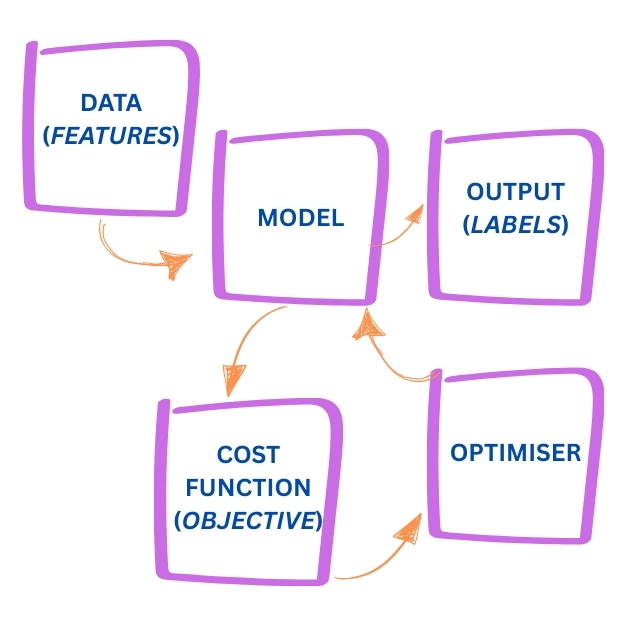
Once development of the model is complete, the first thing we need to do is to train the model. And once a model is finished training it can then be moved as a standalone file where it can be used to provide its desired function. Once we arrive at this point, we no longer need the original data, the objective function, and the optimiser.
The data used to train the model is called the training data set. As is the case across many aspects of information technology, the data becomes of vital importance. And this is no different with AI. The power of the machine learning model comes from the data used to train the model. The better the quality of the data, the better the result from the model. And so even before embarking on your AI journey, it’s important your training data is readily available, structured, and is a quality product.
As we mentioned earlier, a practical example of machine learning is in the field of manufacturing where we employ product visual inspection to look for defects in the manufactured product. In this example of supervised machine learning the data input to the model (the X) would be the product (image of the product) that’s being manufactured. The output from the model would be whether or not the product being manufactured has a defect, such as a scratch on the glass of a mobile phone. Illustrated in the below table:
| Input (X) | Output (Y) | Application |
|---|---|---|
| Mobile phone image | Defect (0 or 1) | Visual inspection |
This example would be classed as a regression algorithm of supervised machine learning. We will delve a little deeper into supervised machine learning in the next article.
I hope this has given you an overview, at least at a high-level, to how machine learning works. Stay tuned for more AI insights in my Wow Bang Boom AI Series.
 Wow Bang Boom®
Leave a comment